

Music: A periodic sequence of vibrating air molecules can make your heart race, your skin prickle with “chills,” or even move you to tears.
For a long time, we treated music as a lovely “extra” in the human story, a bit of auditory entertainment we invented for fun. But modern neuroscience and groundbreaking research, tells a much deeper story. It turns out that your brain isn’t just a passive listener. When the beat drops, your brain is actually running one of the most complex “simulation programs” in the known universe.
It’s time to stop thinking of music as mere entertainment and start seeing it for what it truly is, an ancient biological technology for survival, a stimulus for our cognitive evolution, an impetus for our modern civilization.
The Brain’s Inner Gambler: The Secret of “The Chill”

To understand why music moves us, we have to look at how your brain handles the future. Your brain is a “prediction machine.” Its main job is to guess what’s going to happen next so it can keep you safe.
When you listen to a song, your brain is constantly playing a high-stakes game of “Guess the Next Note.” Scientists call this entropic flux – a fancy way of saying the music is constantly shifting between being predictable and being a surprise.
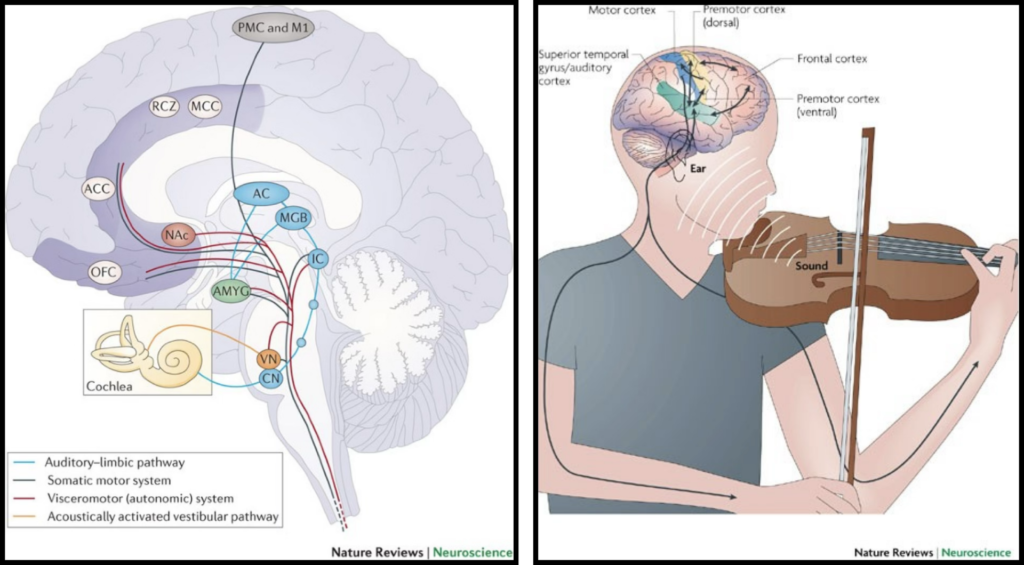
- The Tension: As a melody climbs, your Premotor Cortex (the part of your brain that plans movement) starts “shadow-dancing.” It predicts exactly when the next beat will hit. This creates musical tension.
- The Payoff: When the music follows through on your brain’s “bet”, or surprises you in just the right way, your reward system flashes green. The Nucleus Accumbens floods your system with dopamine.
That “tingle” down your spine? That’s your brain’s way of saying, “I predicted the future correctly, and it feels good!”
The “Hearing-Doing” Loop: Why You Can’t Sit Still

One of the most mind-blowing findings in recent studies is that listening to music is a full-body workout for the brain. Even if you are sitting perfectly still in a chair, the parts of your brain that control your muscles (the Cerebellum and Basal Ganglia) are firing as if you were actually performing the music yourself. This is known as the “hearing-doing” system. Your brain uses your motor system to “simulate” the rhythm to help you understand it.
This is why music is so effective for treating movement disorders like Parkinson’s disease. The music acts as an external “biological clock,” helping the motor system organize itself when it otherwise couldn’t.
Neurobiology of music: A Musical Map of the Brain
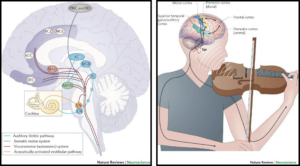
To help you navigate this “internal jam session,” here is a guide to the key players in your brain and what they are doing while you listen to your favorite songs:
| Brain Region | Primary Biological Function | Its “Secret Job” in Music |
| Auditory Cortex | Processing sound | The “Gateway.” It decodes pitch and tone and passes the data to the emotional centers. |
| Premotor Cortex | Planning movements | The “Conductor.” It predicts the rhythm and “rehearses” the beat internally. |
| Nucleus Accumbens | Reward & Pleasure | The “Jackpot.” It releases dopamine when a musical prediction is satisfied. |
| Amygdala | Processing social/threat info | The “Vibe Checker.” It processes the social-emotional “mood” of the music. |
| Hippocampus | Memory & Attachment | The “Memory Keeper.” It links music to our personal history and helps us bond with others. |
| Cerebellum | Coordination & Timing | The “Metronome.” It tracks the precise timing and “metrical” organization of a rhythm. |
| Anterior Insula | Self-awareness & Emotion | The “Feeler.” It helps you “feel” the music in your body (that “gut” feeling). |
| Visual Cortex | Processing sight | The “Illustrator.” It works with the auditory system to create “mental movies” or imagery. |
The Social Glue: Why Music Saved Humanity

If music were just for fun, evolution probably would have gotten rid of it a long time ago. So why did it stay?
The answer lies in Social Attachment.
Early humans who could synchronize their movements (dancing) and their voices (singing) were much more likely to cooperate, communicate, and survive as a tribe. Music activates the Hippocampus, the part of the brain responsible for social bonding.
When we listen to music together, our brains literally begin to “sync up.” We aren’t just hearing the same song; we are sharing a simulated emotional state. This makes music the ultimate “social glue,” allowing humans to form massive, cooperative societies.
Why This Matters for You
The next time you put on your headphones, remember: you aren’t just “killing time.” You are engaging a phylogenetically ancient network designed to keep your brain sharp, your body coordinated, and your social bonds strong.
Music is a gym for your cognition, a pharmacy for your emotions, and a GPS for your social life. It is a fundamental part of being a healthy human being.
The benefits are 10x if you actively participate in music by singing, playing a musical instrument, or jamming with your friends or band. If you have never played music, don’t worry, there is good news for you. We developed a tool just for you. Download QwertyZen Community Edition on your PC and turn your keyboard into a friendly and approachable musical instrument today.