

The Executive Summary
We have a problem of perception. For too long, we have viewed music education as a decorative “extra”—a pleasant diversion for children between math and science. This view is not only outdated; it is economically dangerous.
Music education is actually the foundation of a multi-billion-dollar global industry. It acts as the R&D department for the creative economy, a generator of long-term assets (IP), and the only viable defense against the commoditization of human creativity by Artificial Intelligence. To cut music programs is to cut the fuel line to a massive economic engine. This article maps the journey from the classroom to the economy, identifies the threats we face, and outlines why investing in music is the only path forward.
Part I: The Hero’s Origin (The Hidden Economy)
Every hero needs an origin story. The global creative economy begins not in a boardroom, but in a band room.
When a school invests in music, they aren’t just buying instruments; they are triggering a complex economic chain reaction. This is the “Hidden Economy” that turns a simple lesson into a lifelong revenue stream.
1. The Manufacturing & Retail Backbone
The journey starts with the physical. A student’s need for a violin or a MIDI controller keeps a global network of artisans, factories, and tech developers alive.
- The Supply Chain: From timber for cellos to semiconductors for synthesizers, music education drives demand across manufacturing sectors.
- The Recurring Market: It creates a stable, high-volume ecosystem for retailers and repair technicians. Without the “beginner market,” the professional instrument market collapses.
2. The Asset Class: IP and Copyright
Here is the piece often ignored: Music is a financial asset. Music education teaches students the language of creation. When a student learns to compose, they are learning to generate Intellectual Property (IP).
- The Catalog Economy: The music industry is built on copyrights—publishing, mechanical royalties, and sync licensing. These are tradeable assets that generate yield for decades.
- The Future Owners: By teaching music theory and composition, we are training the next generation of IP owners—the songwriters and producers who will create the soundtracks for films, games, and media, generating exportable culture and tax revenue.
Part II: The New Threat (The Villain)
The hero’s journey is never easy. Today, music education faces a two-pronged attack that threatens to derail this ecosystem.
1. The Erosion of Support
The traditional villain is the budget cut. By removing music from schools, we turn creativity into a luxury good, accessible only to the wealthy. We shrink the talent pool, effectively capping the growth of the creative industries.
2. The Rise of “Synthetic” Culture (AI)
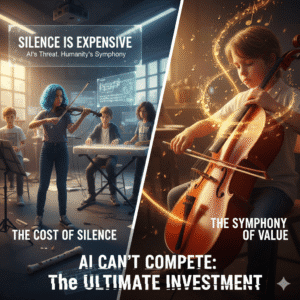
The new, more terrifying villain is Generative AI. Algorithms can now churn out functional, royalty-free background music in seconds. This technology threatens to flood the market with “content” rather than art, devaluing human expression.
- The Threat: If we stop training humans to understand, compose, and perform complex music, we cede the entire field to machines. We risk a future where music is merely programmed noise, not human connection.
- The Defense: Music education is the firewall. AI can mimic, but it cannot feel. By doubling down on education, we emphasize the one thing AI cannot replicate: the human narrative, the communal experience, and the “soul” of performance.
Part III: The Resolution (The Human ROI)
How do we win? We win by realizing that music education builds the one thing the future economy needs most: Resilient Humans.
The journey of learning music creates a specific type of mind—one that is indispensable in the modern workforce.
- The Cognitive Edge: Research proves that musicians possess superior attention, memory, and executive function.
- Emotional Armor: In a fractured society, music provides the tools for empathy, collaboration, and emotional regulation.
- The Ultimate Soft Skill: In an automated world, the ability to think creatively and connect emotionally is the only skill that cannot be automated.
Conclusion: The Final Cadence
We are at a crossroads. We can view music education as a cost to be cut, allowing AI to fill the silence with algorithmic noise. Or, we can recognize it for what it truly is: a critical infrastructure project.
Music education is the training ground for our economy’s innovators. It is the factory for our culture’s intellectual property. It is the sanctuary for our humanity.
The choice is not between “music” and “math.” The choice is between a passive, consumerist society and a vibrant, creative one. To secure our economic and cultural future, we must stop treating music education like a hobby and start treating it like the powerhouse it is.
Let the music play—not for charity, but for our survival.